

Mesophication Pennsylvania: Why Oaks Are Disappearing
- Michael Dunn

- Aug 9
- 4 min read
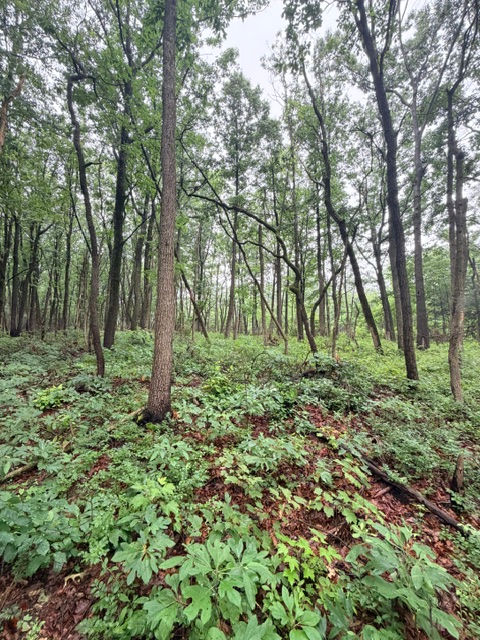
Walk into almost any mature woodlot in Chester, Delaware, Bucks or Montgomery County and you'll likely see a lot of tulip poplar, red maple, and American beech crowding the understory — and very few young oaks. That's not a coincidence. It's the visible signature of a slow, century-long process called mesophication, and it's quietly reshaping the character of southeastern Pennsylvania's forests.
What Mesophication Actually Means
The term was coined in 2008 by forest ecologists Gregory Nowacki and Marc Abrams to describe a feedback loop set in motion when fire is removed from a landscape that evolved with it. Before organized fire suppression began in the 1920s, low-intensity surface fires — many set intentionally by Indigenous communities and later colonial land managers — kept eastern forests relatively open, sunny, and dominated by fire-adapted species like oaks. Oaks tolerate fire well: thick bark, deep roots, and a strong ability to resprout after being top-killed.
Once fire was pulled from the system, shade-tolerant "mesophytic" species — maples, beech, tulip poplar, black birch — began filling in the understory unchecked. These species create exactly the conditions that suppress fire further: denser shade, cooler and damper microclimates, and leaf litter that holds moisture instead of drying into flammable fuel. The result is self-reinforcing: the more mesophytes establish, the harder it becomes for fire — or oak regeneration — to return. Researchers have even given the pattern a name: the "oak bottleneck," where mature oaks still dominate the canopy, but almost none are coming up behind them in the sapling layer.
Why the Piedmont Is Especially Susceptible
Not all forests mesophicate at the same rate. Mesophication moves fastest on rich, moist, fertile ground — exactly the kind of deep, loamy soil that defines much of the Piedmont physiographic province where the Brandywine watershed sits. The Pennsylvania Natural Heritage Program formally recognizes a Piedmont subtype of Mixed Mesophytic Forest on the region's rich mesic lower slopes, already dominated by tuliptree, sugar maple, American beech, and basswood, with red oak persisting mainly in the overstory. On poorer, drier, rocky ridgetops, oaks hang on much longer because mesophytes simply don't compete as well there — but on the fertile lowland soils common across Chester County, the conversion away from oak happens faster and is harder to reverse.
The Evidence Along Brandywine Creek
This isn't just theoretical for our watershed — it's been studied here directly. In 2006, Chester County Parks and Recreation carried out a prescribed burn on roughly 5.9 hectares of woodland at Hibernia County Park, on a south-facing bank of the West Branch of Brandywine Creek, in a stand classified as a tulip poplar/red maple association. The burn plan explicitly targeted the classic mesophytic oak competitors — tulip poplar, American beech, and red maple saplings — alongside invasive shrubs and vines, with the goal of promoting oak regeneration.
Six years of monitoring after that single dormant-season fire found real, measurable effects: Japanese honeysuckle and multiflora rose cover both dropped significantly (honeysuckle fell from a baseline mean of 22.5 point-intercepts to 13.6; multiflora rose from 16.5 to 10.3), and native woody stem counts and species richness rose. The researchers ultimately recommended a five-year prescribed fire rotation for the site, paired with mechanical removal in wet pockets that wouldn't carry fire well — a practical, local blueprint for pushing back against mesophication in exactly this kind of Piedmont woodland.
A Compounding Problem: Invasives and Deer
Mesophication rarely operates alone. The same Hibernia study documented a suite of invasive species thriving in the shaded, fire-excluded understory — Japanese honeysuckle, multiflora rose, oriental bittersweet, Japanese knotweed, Norway maple, and tree-of-heaven among them. And across the wider Piedmont, elevated deer populations add a second layer of pressure: heavy browsing has already decimated the understory of dry oak-heath forest types in this region, removing what oak seedlings do manage to germinate before they ever get a chance to compete with maple and beech. Fire exclusion, invasive plants, and deer browse form a mutually reinforcing set of stressors working against oak regeneration at the same time.
Why This Matters
Oaks aren't just another tree species — they're a keystone of eastern forest ecology and a major economic asset. Nationally, oaks and pines rank as the two most valuable tree genera when timber and ecosystem-service values are combined, with oak alone valued above $22 billion. Oaks also support dramatically more caterpillar and insect biomass than maple or beech, making them a foundational food source for breeding birds. As mesophication proceeds, researchers project that stand-level species richness will keep declining as a wide range of fire-adapted plants get replaced by a narrower set of shade-tolerant species — a simplification of forest structure, not just a shuffling of species.
Reversing the Trend
The encouraging news is that mesophication isn't necessarily permanent. A 2024 study tracking two decades of repeated prescribed fire in eastern oak forests found that fire — alone or combined with mechanical thinning — significantly reversed the mesophication trajectory, reducing mesophytic tree density in the midstory and sapling layers while boosting oak-hickory regeneration, particularly on dry and intermediate sites. Mechanical treatment alone, without fire, didn't produce the same shift — underscoring that fire itself, not just canopy thinning, is doing the ecological work.
For woodland owners, park managers, and municipalities across the Brandywine watershed, that's a call to action rather than a reason for alarm. Prescribed fire, applied on a defensible rotation and paired with invasive species control and deer management, is a proven, science-backed tool for holding the line on oak dominance in exactly this kind of Piedmont forest. As a Pennsylvania Forest Fire Warden and consulting arborist, Michael B. Dunn, RCA BCMA works with landowners and municipalities throughout the region to design forest management and prescribed burn plans that address mesophication before it reaches the point of no return.
Sources:
Nowacki, G.J. and Abrams, M.D., "The Demise of Fire and Mesophication of Forests in the Eastern United States" — https://oakfirescience.com/the-demise-of-fire-and-mesophication-of-forests-in-the-eastern-united-states/
"Mesophication of Oak Landscapes: Evidence, Knowledge Gaps, and Future Research," BioScience, 2021 — https://academic.oup.com/bioscience/article/71/5/531/6117972
Pennsylvania Natural Heritage Program, "Mixed Mesophytic Forest" — https://www.naturalheritage.state.pa.us/Community.aspx?=16057
Pennsylvania Natural Heritage Program, "Dry Oak-Heath Forest" — https://www.naturalheritage.state.pa.us/Community.aspx?=16059
Welch, J.M., "Invasive and Native Plant Response to Fire in a Pennsylvania Piedmont Woodland" (Hibernia County Park / Brandywine Creek study) — https://msaag.aag.org/wp-content/uploads/2014/10/3-Welch-MSG4521-2820121.pdf
Legge, E.S. et al., Forest Ecology and Management — https://sydneyglassman.wordpress.com/wp-content/uploads/2025/10/leggeetalfem2025.pdf
Hutchinson, T.F. et al., "Sustaining eastern oak forests: Synergistic effects of fire and topography on vegetation and fuels," 2024 — https://pubmed.ncbi.nlm.nih.gov/38351586/


Comments