

Learning to Love the Broken Tree: Habitat Trees and the Case for Ecological Arboriculture


Every arborist has stood at the base of a tree that makes a client nervous. A hollow trunk. A dead limb hanging over the driveway. A cavity big enough to put your head in. The instinct — often the client's, sometimes the arborist's — is to clean it up: prune the deadwood, fill the cavity, or take the whole tree down before it becomes a liability. But a growing body of European forestry science, decades of British veteran-tree management practice, and a newer school of American "ecological arboriculture" all point to the same conclusion: the ugliest, most decayed trees in a landscape are often doing the most ecological work. Removing them by default doesn't reduce risk so much as it quietly hollows out the biodiversity of the woodlands we're trying to protect.
What Actually Makes a Tree a "Habitat Tree"
Forest ecologists define habitat trees as standing live or dead trees that provide microhabitats — cavities, bark pockets, large dead branches, epiphytes, cracks, and sap runs — that other species depend on for food, shelter, or reproduction (Bütler et al., WSL). These features are sometimes called tree-related microhabitats, or TreMs, and they accumulate almost exclusively on old, large, stressed, or structurally compromised trees — precisely the trees a risk-averse removal schedule tends to target first.
The scale of retention recommended in European silviculture is worth sitting with: forest management guidance calls for retaining at least five to ten habitat trees per hectare specifically to offset the biodiversity loss from timber harvesting, prioritizing older, larger, and already-decaying individuals over healthy, uniform stock (Bütler et al., WSL). That's a deliberate ecological trade-off — sacrificing a small amount of timber value or visual tidiness for outsized habitat return. It's a trade-off we rarely make explicitly in fragmented Mid-Atlantic woodlands, where every legacy tree is doing more ecological work than its counterpart in an intact forest, simply because there's so little old structure left standing nearby.
The British Blueprint: Veteran Tree Management
Britain has been formalizing this thinking longer than we have. The Ancient Tree Forum's "Veteran Trees: A Guide to Good Management" — originally published by English Nature and now maintained with the Woodland Trust — set the template much of the English-speaking arboriculture world still references for trees showing wounds, decay, hollowing, or other habitat features associated with great age. Its follow-up, "Guidance on Managing Ancient and Other Veteran Trees", is blunt about the default: do nothing. Let the tree decline naturally, protect it from disturbance, and intervene only when there is a genuine, specific risk.
Two ideas from that framework are worth importing directly into American practice. First, the root protection area recommended for a veteran tree is far more generous than the Critical Root Zone math most of us learned: fifteen times the trunk diameter, or five meters beyond the canopy, whichever is greater — compared to the one-to-one-and-a-half-foot-per-inch-of-DBH standard most U.S. municipalities still write into ordinary tree ordinances. Second is "halo clearance": instead of pruning or treating the veteran tree itself, you manage the vegetation competing around it, opening light and reducing competition without ever touching the tree's own structure. Both ideas reframe veteran-tree care as landscape management around the tree, not intervention on it — protection by leaving well enough alone.
Ecological Arboriculture in Practice: Chris Roddick's Model
On this side of the Atlantic, Christopher Roddick has become one of the clearest voices translating this thinking into practical, teachable arboriculture. After thirty years as head arborist and foreman of grounds at the Brooklyn Botanic Garden, Roddick founded Sweet Birch Land & Tree, an arboricultural consultancy now based in southern New England. He calls his approach Conservation Arboriculture, or Ecological Arboriculture: treating each tree as a tree-based ecosystem rather than an isolated specimen, and drawing on soil biology, organic land care principles, and modern ecological research — rather than purely cosmetic or risk-driven standards — to decide what care a tree actually needs. Roddick is an ISA Certified Arborist and a NOFA Accredited Organic Land Care Professional, author of the Tree Care Primer, and has taught this framework through Morris Arboretum's Certificate in Ecological Horticulture program and the University of Pennsylvania's Earth Week programming, among others.
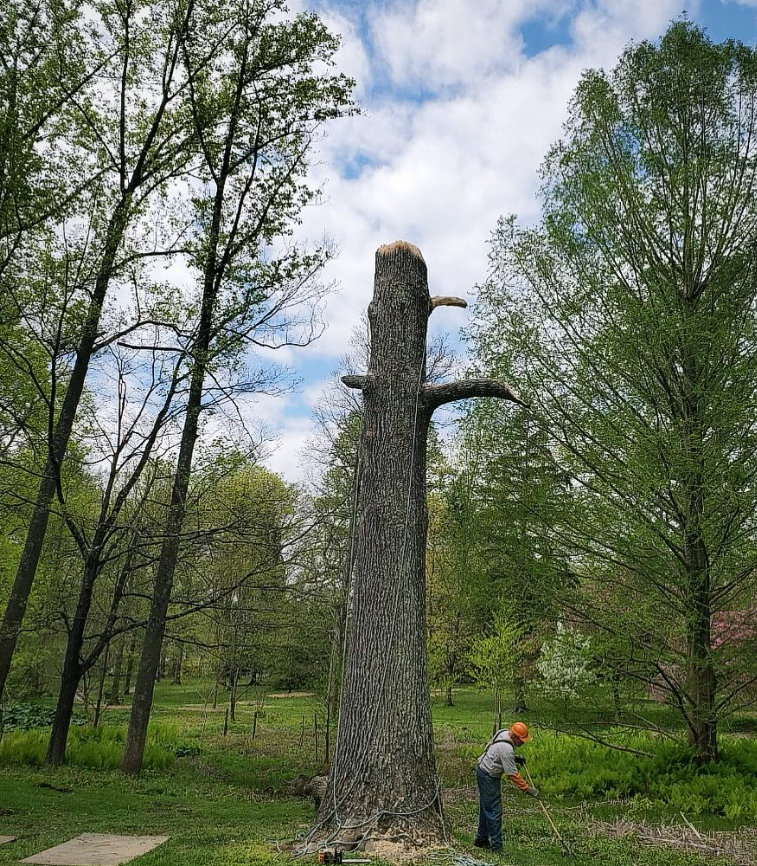
The through-line in Roddick's teaching — and in the broader ecological-arboriculture literature — is a simple discipline a recent peer-reviewed proposal has usefully labeled the "4-R approach": Respect, Reduce, Retain, Reassess. Respect the ecological value of deadwood and microhabitats before deciding they're a problem. Reduce pruning to what's genuinely necessary, not routine tidying. Retain deadwood on-site wherever safety allows — using techniques like fracture pruning and coronet cuts that mimic the ragged breaks trees create naturally, instead of the clean flush cuts conventional pruning defaults to — and when wood must come down, leave it near the tree's base to decompose in place rather than hauling it away. Reassess before acting again: give a tree time to respond to an intervention instead of treating every visible issue on the same maintenance cycle.
Why This Matters Close to Home
This isn't an abstract European debate. It's directly relevant to exactly the kind of landscape we work in across the Brandywine watershed: small, fragmented forest parcels, suburban lots, and municipal park trees, where a single retained snag or a veteran oak with a hollow limb can be the only cavity-nesting or saproxylic-insect habitat for a wide radius. That doesn't mean ignoring genuine hazards — a proper risk assessment always comes first, and public safety is never negotiable. But it does mean building habitat-tree designation and veteran-tree protocols into forest management plans and tree preservation ordinances as their own category, distinct from routine risk management, instead of defaulting every declining tree into the same removal queue.
This framework increasingly shapes how I approach management plans, retention recommendations, and tree preservation studies for clients across the region — identifying which declining or structurally interesting trees on a property are candidates for retention as habitat features, managed through monitoring and halo clearance rather than removal, versus which genuinely need to come down. It's a more nuanced conversation than "healthy tree, keep; unhealthy tree, remove" — but it's the conversation that actually protects the biodiversity our forest fragments have left.
Sources:
Ancient Tree Forum & Woodland Trust, "Veteran Trees: A Guide to Good Management" — https://www.ancienttreeforum.org.uk/wp-content/uploads/2015/03/Veteran-Trees-A-Guide-to-Good-Management-almost-complete.pdf
Ancient Tree Forum, "Guidance on Managing Ancient and Other Veteran Trees" (2016) — https://www.ancienttreeforum.org.uk/wp-content/uploads/2016/11/Guidance-on-managing-ancient-and-other-veteran-trees.pdf
Bütler, R., et al., "Habitat Trees: Key Elements for Forest Biodiversity," WSL — https://www.wsl.ch/fileadmin/user_upload/WSL/Mitarbeitende/buetler/InFocus-Integrate-chapterHabitat_trees-final.pdf
"How Neglecting the Ecological Value of Habitat Trees Threatens Urban Biodiversity" (4-R approach), Urban Ecosystems, 2026 — https://link.springer.com/article/10.1007/s11252-026-02036-x
University of Pennsylvania Sustainability, Earth Week: Ecological Arboriculture Workshop with Christopher Roddick — https://www.sustainability.upenn.edu/events/earth-week-ecological-arboriculture-workshop
Morris Arboretum & Gardens, Certificate in Ecological Horticulture — Christopher Roddick bio — https://www.morrisarboretum.org/learn-discover/certificate-ecological-horticulture
Connecticut College, SALT Conference — Christopher Roddick, Sweet Birch Land & Tree — https://www.conncoll.edu/salt/
Buglife, "Managing Dead and Decaying Wood" Habitat Management Guide — https://cdn.buglife.org.uk/2022/01/BFTB-Advice-Sheet-Managing-Dead-and-Decaying-Wood.FINAL_.pdf
Forest Research (UK), "A Guide to Managing Deadwood in Forestry Commission Woodlands" — https://cdn.forestresearch.gov.uk/2022/02/lifeinthedeadwood.pdf


Comments